Documentation
Elements
- <a>
- <altRepresentation>
- <aside>
- <assessment>
- <author>
- <backcover>
- <blockquote>
- <body>
- <bodymatter>
- <caption>
- <code>
- <cover>
- <dd>
- <dl>
- <document>
- <dt>
- <em>
- <figure>
- <figureGroup>
- <frame>
- <frontcover>
- <frontmatter>
- <hd>
- <img>
- <indicators>
- <input>
- <jacketcopy>
- <legend>
- <li>
- <line>
- <linegroup>
- <list>
- <meta>
- <metadata>
- <note>
- <noteRef>
- <p>
- <pagebreak>
- <poem>
- <publication>
- <pullquote>
- <rearmatter>
- <section>
- <source>
- <span>
- <sub>
- <subtitle>
- <sup>
- <table>
- <tbody>
- <td>
- <tfoot>
- <th>
- <thead>
- <title>
- <tr>
KERN Nederlands Oefenboek/Oefen- en Examenboek
Book structure
Use the table of contents to determine the sectioning structure. See Sectioning for more information. For headings that are not mentioned in the table of contents, use hd without the level attribute.
References to Handboek
Sometimes the chapter number and title are repeated across the pages. There is no need to process the chapter number and title each time. However, the line that appears below the chapter number should be processed when it appears. See example below.

<section level="2" role="subChapter">
<p>HANDBOEK: VERHALEN & GEDICHTEN ▶ 1 KIEZEN EN LEZEN VAN BOEKEN</p>
<hd level="2" label= "subChapter" number="E">E Kiezen en lezen van boeken</hd>Table of contents
special table of contents
Only process real toc entries as the list items of the list role=”toc”. In addition, capture the table of contents as a figure with an altRepresentation. Fill the altRepresentation with a table as in the print.
See also: Tables of contents > ‘Special or graphical tables of contents’.
Notice how in the example below Thema 6, 7, 8 and 9 are below the other thema’s. In the table you can put these themes directly next to Thema 5, so all the Thema’s are on the same row.
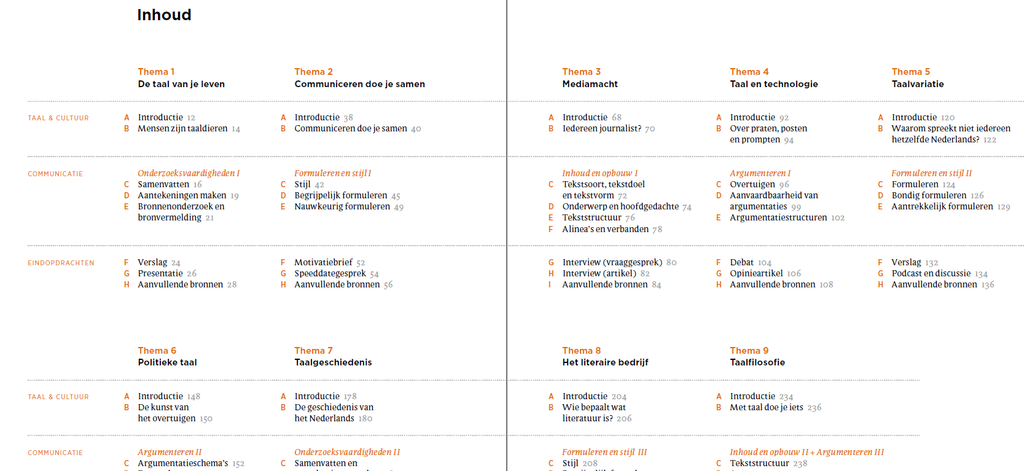
The rest of the TOC should be processed with <p> and <list>, see Tables of contents.
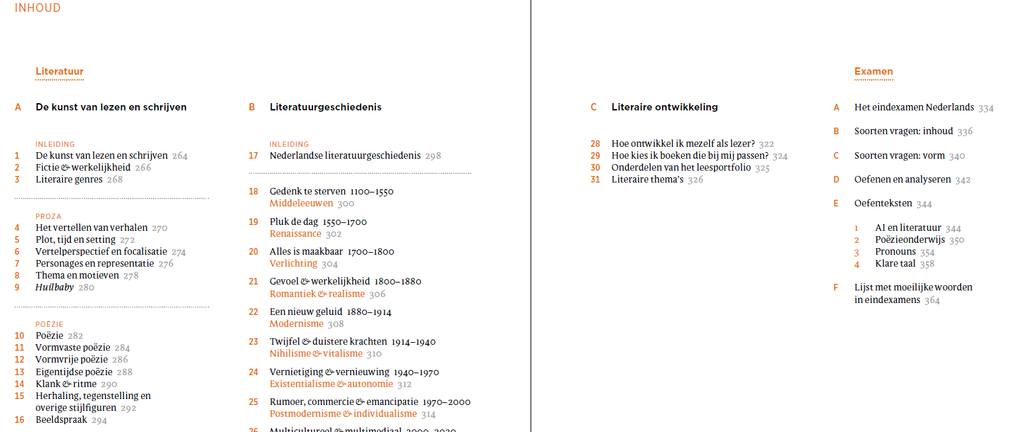
Chapter TOC
Process the table of content at the beginning of each chapter as a <table> with rowspan.
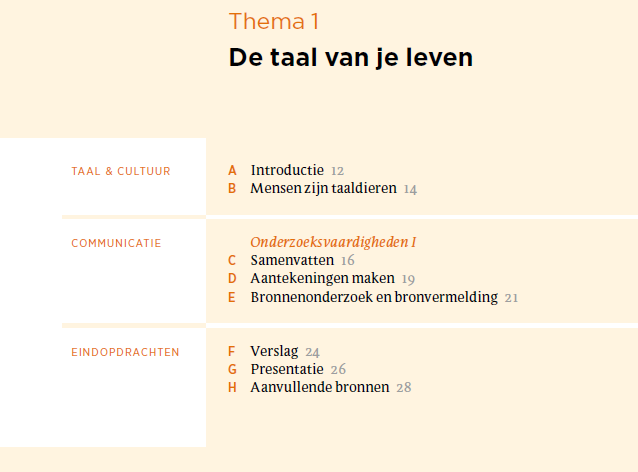
<table>
<tbody>
<tr>
<th rowspan="2">TAAL & CULTUUR</th>
<td>A Introductie <a type="pageRef" href="#pb-12">12</a></td>
</tr>
<tr>
<td>B Mensen zijn taaldieren <a type="pageRef" href="#pb-14">14</a></p>
</tr>
<tr>
<th rowspan="4">COMMUNICATIE</th>
<td fontStyles="italic">Onderzoeksvaardigheden I</p></td>
</tr>
<tr>
<td>C Samenvatten <a type="pageRef" href="#pb-16">16</a></td>
</tr>
<tr>
<td>D Aantekeningen maken <a type="pageRef" href="#pb-19">19</a></td>
</tr>
…
</tbody>
</table>Headings and ▶
The ▶ symbol is used to indicate different containers of text. They are used for:
- headings
<hd> - text in
<p> - list items
<li>
Use of ▶ in headings, p and list
Text in bold preceded by a ▶ is often a heading without level, as seen in the example below.
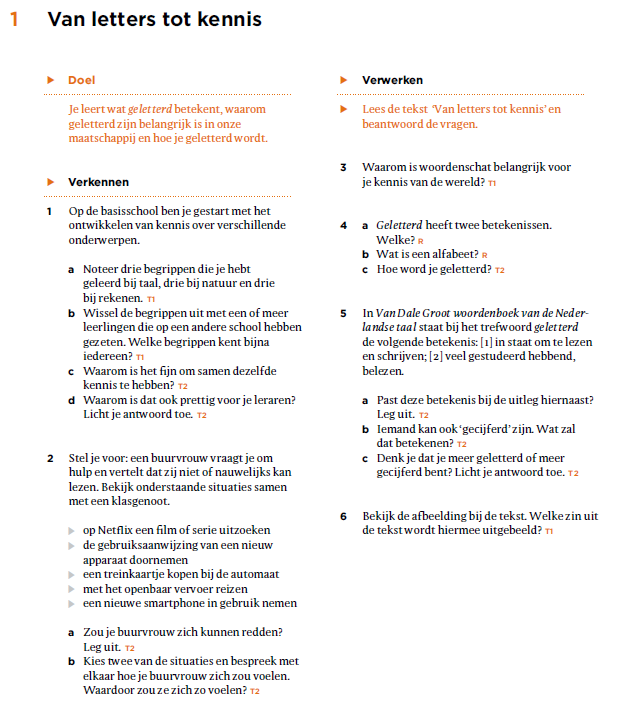
<section level="2" role="subChapter">
<hd level="2" number="1" label="subChapter">1 Van letters tot kennis</hd>
<hd>▶ Doel</hd>
<p foregroundColor="orange">Je leert wat <em type="italic">geletterd</em> betekent, waarom geletterd zijn belangrijk is in onze maatschappij en hoe je geletterd wordt.</p>
<hd>▶ Verkennen</hd>
<assessment>
<title number="1" label="assessment">1</title>
<p>Op de basisschool ben je gestart met het ontwikkelen van kennis over verschillende onderwerpen.</p>
<p><em type="bold">a</em> Noteer drie begrippen die je hebt geleerd bij taal, drie bij natuur en drie bij rekenen. T1</p>
<p><em type="bold">b</em> Wissel de begrippen uit met een of meer leerlingen die...</p>
...
</assessment>

<assessment>
<title number="2" label="assessment">2</title>
<p>Stel je voor: een buurvrouw vraagt je om hulp en vertelt dat zij niet of nauwelijks kan lezen. Bekijk onderstaande situaties samen met een klasgenoot.</p>
<list listType="unordered" bulletType="predefined">
<li>▶ op Netflix een film of serie uitzoeken</li>
<li>▶ de gebruiksaanwijzing van een nieuw apparaat doornemen</li>
<li>▶ een treinkaartje kopen bij de automaat</li>
<li>▶ met het openbaar vervoer reizen</li>
<li>▶ een nieuwe smartphone in gebruik nemen</li>
</list>
<p><em type="bold">a</em> Zou je buurvrouw zich kunnen redden? Leg uit. T2</p>
...
</assessment>

<hd>▶ Verwerken</hd>
<p foregroundColor="orange">▶ Lees de tekst 'Van letters tot kennis' en beantwoord de vragen.
<assessment>
<title number="3" label="assessment">3</title>
<p>Waarom is woordenschat belangrijk voor je kennis van de wereld? T1</p>
<assessment>
<title number="4" label="assessment">4</title>
<p><em type="bold">a</em> <em type="italic">Geletterd</em> heeft twee betekenissen. Welke? R</p>
<p><em type="bold">b</em> Wat is een alfabeet? R</p>
<p><em type="bold">c</em> Hoe wordt je geletterd? T2</p>
</assessment>
...
Text formatting
This series uses a lot of colored text. As a general rule:
- Do NOT use <em> with foregroundcolor for the colored text parts.
- Only use foregroundcolor if it can be placed on container elements (like <p> and <list> for example)
Lists
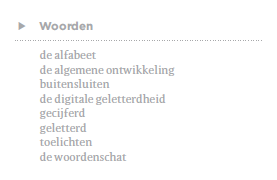
<p foregroundColor="gray">▶ Woorden</p>
<list listType="unordered" bulletType="none" foregroundColor="gray">
<li>de alfabeet</li>
<li>de algemene ontwikkeling</li>
<li>buitensluiten</li>
...
</list>
Frames
Text with a colored background are frames. Sometimes this can be whole pages.
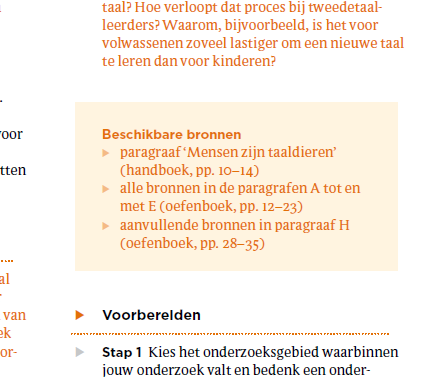
<frame>
<title>Beschikbare bronnen</title>
<list listType="unordered" bulletType="predefined">
<li>▶ paragraaf 'Mensen zijn taaldieren' (handboek, pp. 10-14)</li>
<li>▶ alle bronnen in de paragrafen A tot en met E (oefenboek, pp. 12-23)</li>
<li>▶ aanvullende bronnen in paragraaf H (oefenboek, pp 28-35)</li>
</list>
</frame>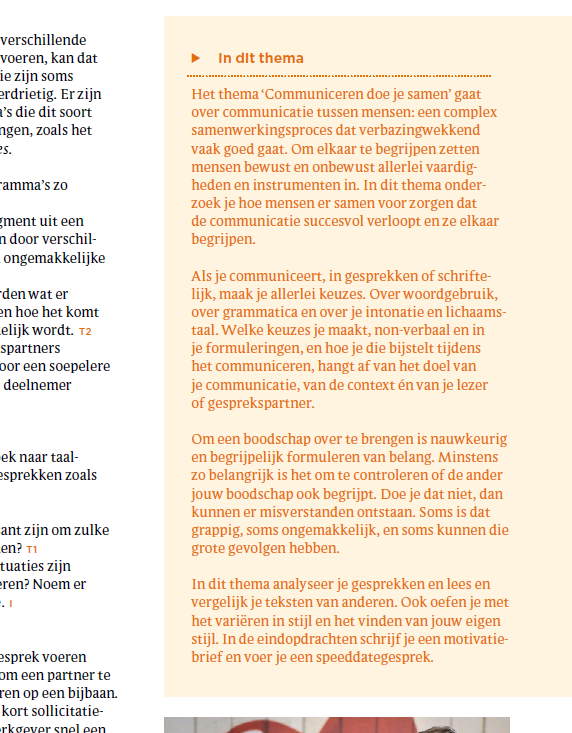
<frame>
<title>▶ In dit thema</title>
<p>Het thema ‘Communiceren doe je samen’ gaat over communicatie tussen mensen: een complex samenwerkingsproces dat verbazingwekkend vaak goed gaat. Om elkaar te begrijpen zetten mensen bewust en onbewust allerlei vaardigheden en instrumenten in. In dit thema onderzoek je hoe mensen er samen voor zorgen dat de communicatie succesvol verloopt en ze elkaar begrijpen.</p>
<p type="precedingEmptyLine">Als je communiceert, in gesprekken of schriftelijk, maak je allerlei keuzes. Over woordgebruik, over grammatica en over je intonatie en lichaamstaal. Welke keuzes je maakt, non-verbaal en in je formuleringen, en hoe je die bijstelt tijdens het communiceren, hangt af van het doel van je communicatie, van de context én van je lezer of gesprekspartner.</p>
...
</frame>
Frame in frame
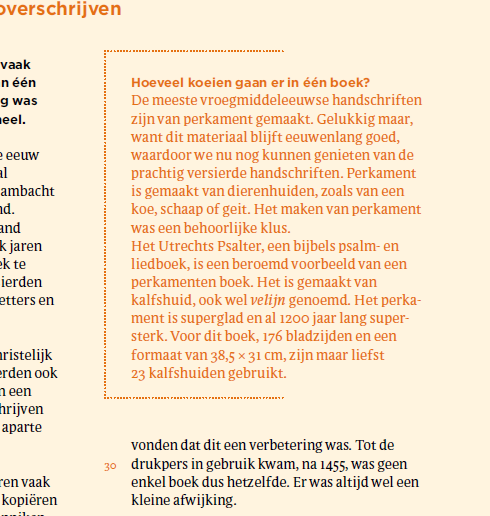
In the example below there is a <frame> (text between the lines) within a <frame> (colored page).
Exception
- if the whole chapter has colored background pages, then the text in white blocks are frames.
- This is the case for excample, in the chapters labeled “aanvullende bronnen” in the Oefen- en Examenboek.
<frame>
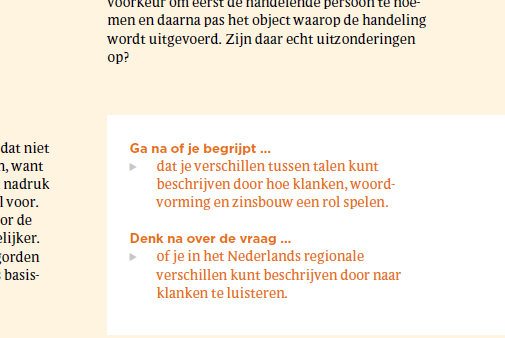
<p fontStyles="bold">Ga na of je begrijpt...</p>
<p>▶ dat je verschillen tussen talen kunt beschrijven door hoe klanken, woordvorming en zinsbouw een rol spelen.</p>
<p fontStyles="bold" type= "precedingEmptyLine">Denk na over de vraag...</p>
<p>▶ of je in het Nederlands regionale verschillen kunt beschrijven door naar klanken te luisteren.</p>
Lines connecting text parts
Sometimes text parts are connected with lines. You can ignore the lines and just process the text on the page. Process the text on the left first and the text in grey below that.
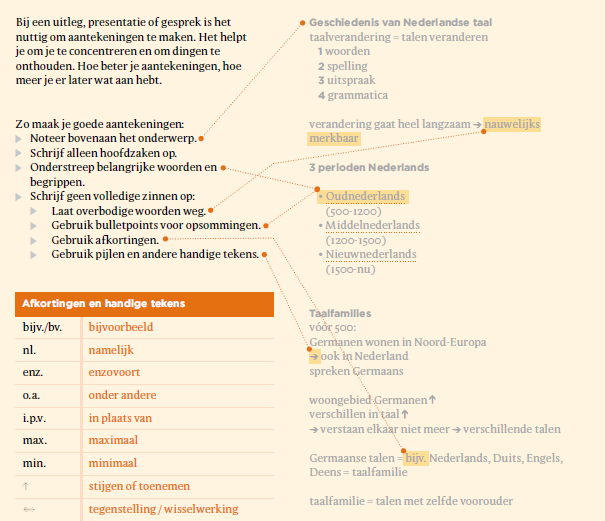
<p>Bij een uitleg, presentatie of gesprek is het nuttig om aantekeningen te maken. Het helpt je om je te concentreren en om dingen te onthouden. Hoe beter je aantekeningen, hoe meer je er later wat aan hebt.</p>
<p type="precedingEmptyLine">Zo maak je goede aantekeningen:</p>
<list listType="unordered" bulletType="predefined">
<li>▶ Noteer bovenaan het onderwerp.</li>
<li>▶ Schrijf alleen hoofdzaken op.</li>
<li>▶ Onderstreep belangrijke woorden en
begrippen.</li>
<li>▶ Schrijf geen volledige zinnen op:
<list listType="unordered" bulletType="predefined">
<li>▶ Laat overbodige woorden weg.</li>
<li>▶ Gebruik bulletpoints voor opsommingen.</li>
<li>▶ Gebruik afkortingen.</li>
<li>▶ Gebruik pijlen en andere handige tekens.</li>
</list>
</list>
<table>
...
</table>
<p fontStyles="bold" foregroundColor="gray">Geschiedenis van Nederlandse taal</p>
<p foregroundColor="gray">taalverandering = talen veranderen</p>
<list listType="ordered" numberType="decimal" foregroundColor="gray">
<li>woorden</li>
<li>spelling</li>
<li>uitspraak</li>
<li>grammatica</li>
<p type="precedingEmptyline" foregroundColor="gray">verandering gaat heel langzaam ➔ <em backgroundColor="yellow">nauwelijks merkbaar</em></p>
...
Linegroup
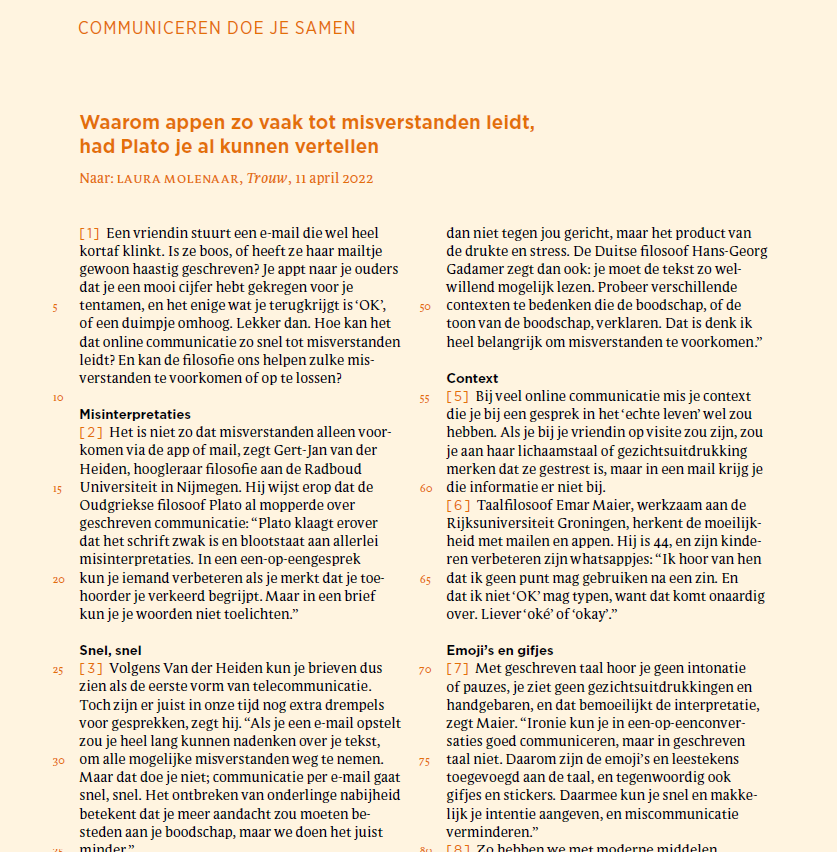
<hd>Waarom appen zo vaak tot misverstanden leidt, had Plato je al kunnen vertellen</hd>
<p>Naar: Laura Molenaar, Trouw, 11 april 2022</p>
<linegroup number="1">
<line>Een vriendin stuurt een e-mail die wel heel</line>
<line>kortaf klinkt. Is ze boos, of heeft ze haar mailtje</line>
<line>gewoon haastig geschreven? Je appt naar je ouders</line>
<line>dat je een mooi cijfer hebt gekregen voor je</line>
<line number="5">tentamen, en het enige wat je terugkrijgt is ‘OK’,</line>
<line>of een duimpje omhoog. Lekker dan. Hoe kan het</line>
<line>dat online communicatie zo snel tot misverstanden</line>
<line>leidt? En kan de filosofie ons helpen zulke mis-</line>
<line>verstanden te voorkomen of op te lossen?</line>
<line number="10"></line>
</linegroup>
<linegroup number="2">
<line role="heading">Misinterpretaties</line>
<line>Het is niet zo dat misverstanden alleen voor-</line>
<line>komen via de app of mail, zegt Gert-Jan van der</line>
<line>Heiden, hoogleraar filosofie aan de Radboud</line>
<line number="15">Universiteit in Nijmegen. Hij wijst erop dat de</line>
<line>Oudgriekse filosoof Plato al mopperde over</line>
<line>geschreven communicatie: “Plato klaagt erover</line>
<line>dat het schrift zwak is en blootstaat aan allerlei</line>
<line>misinterpretaties. In een een-op-eengesprek</line>
<line number="20">kun je iemand verbeteren als je merkt dat je toe-</line>
<line>hoorder je verkeerd begrijpt. Maar in een brief</line>
<line>kun je je woorden niet toelichten.”</line>
</linegroup>
...
Notes
Use note and noteRef in cases like the example below.
<frame>
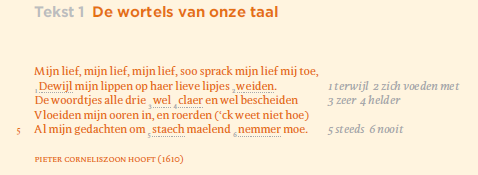
<title>Tekst 1</title>
<subtitle>De wortels van onze taal</subtitle>
<poem foregroundColor="orange">
<linegroup>
<line>Mijn lief, mijn lief, mijn lief, soo sprack mijn lief mij toe,</line>
<line><noteRef idRef="note-1">1</noteRef> <em type="underline">Dewijl</em> mijn lippen op haer lieve lipjes <noteRef idRef="note-2">2</noteRef> <em type="underline">weiden</em>.</line>
<line>De woordtjes alle drie <noteRef idRef="note-3">3</noteRef> <em type="underline">wel</em> <noteRef idRef="note-4">4</noteRef> <em type="underline">claer</em> en wel bescheiden</line>
<line>Vloeiden mijn ooren in, en roerden (‘ck weet niet hoe)</line>
<line number="5">Al mijn gedachten om <noteRef idRef="note-5">5</noteRef> <em type="underline">staech</em> maelend <noteRef idRef="note-6">6</noteRef> <em type="underline">nemmer</em> moe.</line>
</linegroup>
<source>Pieter Corneliszoon Hooft (1610)</source>
</poem>
<note id="note-1" type="footNote"><p fontStyles="italic">1 terwijl</p></note>
<note id="note-2" type="footNote"><p fontStyles="italic">2 zich voeden met</p></note>
<note id="note-3" type="footNote"><p fontStyles="italic">3 zeer</p></note>
<note id="note-4" type="footNote"><p fontStyles="italic">4 helder</p></note>
<note id="note-5" type="footNote"><p fontStyles="italic">5 steeds</p></note>
<note id="note-6" type="footNote"><p fontStyles="italic">6 nooit</p></note>
..
</frame>