Documentation
Elements
- <a>
- <altRepresentation>
- <aside>
- <assessment>
- <author>
- <backcover>
- <blockquote>
- <body>
- <bodymatter>
- <caption>
- <code>
- <cover>
- <dd>
- <dl>
- <document>
- <dt>
- <em>
- <figure>
- <figureGroup>
- <frame>
- <frontcover>
- <frontmatter>
- <hd>
- <img>
- <indicators>
- <input>
- <jacketcopy>
- <legend>
- <li>
- <line>
- <linegroup>
- <list>
- <meta>
- <metadata>
- <note>
- <noteRef>
- <p>
- <pagebreak>
- <poem>
- <publication>
- <pullquote>
- <rearmatter>
- <section>
- <source>
- <span>
- <sub>
- <subtitle>
- <sup>
- <table>
- <tbody>
- <td>
- <tfoot>
- <th>
- <thead>
- <title>
- <tr>
KERN Nederlands Leerwerkboek
Book structure
Use the table of contents to determine the sectioning structure. See Sectioning for more information. For headings that are not mentioned in the table of contents, use hd without the level attribute.
Table of contents
This series contains a special table of contents. Only process real toc entries as the list items of the list role=”toc”. In addition, capture the table of contents as a figure with an altRepresentation. Fill the altRepresentation with a table as in the print.
See also: Tables of contents – MONET > ‘Special or graphical tables of contents’.
First process part with chapters 1-4 with <figure> and <altRepresentation>.
(No need to process text in last column in <altRepresentation>: SPREKEN, LEZEN, etc.)
Then process table of contents with <p> and <list> with role="toc".
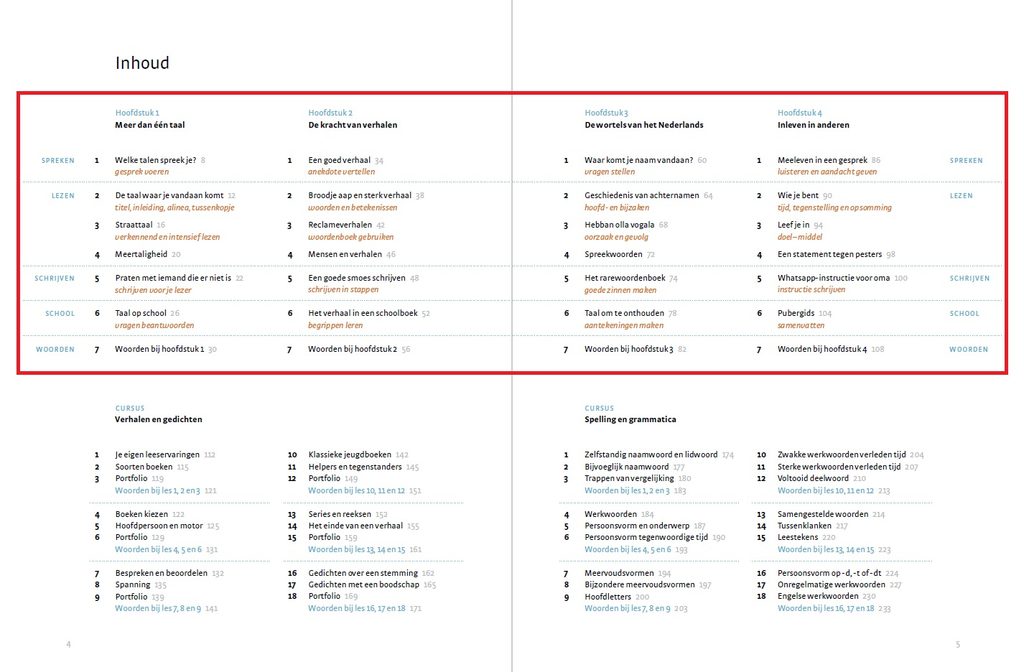
<section level="1" role="toc">
<pagebreak id="pb-4">4</pagebreak>
<hd level="1">Inhoud</hd>
<figure>
<img alt="" role="informative" src="/img/000000_p000-toc.jpg" type="screenshot">
<altRepresentation>
<table>
<thead>
<tr>
<th></th>
<th>Hoofdstuk 1 Meer dan één taal</th>
<th>Hoofdstuk 2 De kracht van verhalen</th>
<th>Hoofdstuk 3 De wortels van het Nederlands</th>
<th>Hoofdstuk 4 Inleven in anderen</th>
</tr>
</thead>
<tbody>
<tr>
<th>SPREKEN</th>
<td><p>1 Welke talen spreek je? <a type="pageRef" href="#pb-8">8</a></p>
<p>gesprek voeren</p></td>
<td><p>1 Een goed verhaal <a type="pageRef" href="#pb-34">34</a></p>
<p>anekdote vertellen</p></td>
<td><p>1 Waar komt je naam vandaan? <a type="pageRef" href="#pb-60">60</a></p>
<p>vragen stellen</p></td>
<td><p>1 Meeleven in een gesprek <a type="pageRef" href="#pb-86">86</a></p>
<p>luisteren en aandacht geven</p></td>
</tr>
<tr>
<th rowspan="3">LEZEN</th>
<td><p>2 De taal waar je vandaan komt <a type="pageRef" href="#pb-12">12</a></p>
<p>titel, inleiding, alinea, tussenkopje</p></td>
…
</tr>
<tr>
<td><p>3 Straattaal <a type="pageRef" href="#pb-16">16</a></p>
<p>verkennend en intensief lezen</p></td>
…
</tr>
<tr>
<td>4 Meertaligheid <a type="pageRef" href="#pb-20">20</a></td>
…
</tr>
<tr>
<th>SCHRIJVEN</th>
<td><p>5 Praten met iemand die er niet is <a type="pageRef" href="#pb-22">22</a></p>
<p>schrijven voor je lezer</p></td>
…
</tr>
<tr>
<th>SCHOOL</th>
<td><p>6 Taal op school <a type="pageRef" href="#pb-26">26</a></p>
<p>vragen beantwoorden</p></td>
…
</tr>
<tr>
<th>WOORDEN</th>
<td>7 Woorden bij hoofdstuk 1 <a type="pageRef" href="#pb-30">30</a></td>
…
</tr>
</tbody>
</table>
</altRepresentation>
</img>
</figure>
<p>Hoofdstuk 1 Meer dan één taal</p>
<list listType="ordered" numberType="predefined" role="toc">
<li number="1">Welke talen spreek je <a type="pageRef" href="#pb-8">8</a></li>
<li number="2">De taal waar je vandaan komt <a type="pageRef" href="#pb-12">12</a></li>
<li number="3">Straattaal <a type="pageRef" href="#pb-16">16</a></li>
…
</list>
<p>Hoofdstuk 2 De kracht van verhalen</p>
<list listType="ordered" numberType="predefined" role="toc">
<li number="1">Een goed verhaal <a type="pageRef" href="#pb-34">34</a></li>
…
</list>
…
<p>CURSUS Verhalen en gedichten</p>
<list listType="ordered" numberType="predefined" role="toc">
<li number="1">Je eigen leeservaringen <a type="pageRef" href="#pb-112">112</a></li>
<li number="2">Soorten boeken <a type="pageRef" href="#pb-115">115</a></li>
<li number="3">Portfolio <a type="pageRef" href="#pb-119">119</a></li>
<li>Woorden bij les 1, 2 en 3 <a type="pageRef" href="#pb-121">121</a></li>
<li number="4">Boeken kiezen <a type="pageRef" href="#pb-122">122</a></li>
<li number="5">Hoofdpersoon en motor <a type="pageRef" href="#pb-125">125</a></li>
<li number="6">Portfolio <a type="pageRef" href="#pb-129">129</a></li>
<li>Woorden bij les 4, 5 en 6 <a type="pageRef" href="#pb-131">131</a></li>
…
</list>
<p>CURSUS Spelling en grammatica</p>
<list listType="ordered" numberType="predefined" role="toc">
<li number="1">Zelfstandig naamwoord en lidwoord <a type="pageRef" href="#pb-174">174</a></li>
…
</list>
</section>
Table of contents at begin of each chapter
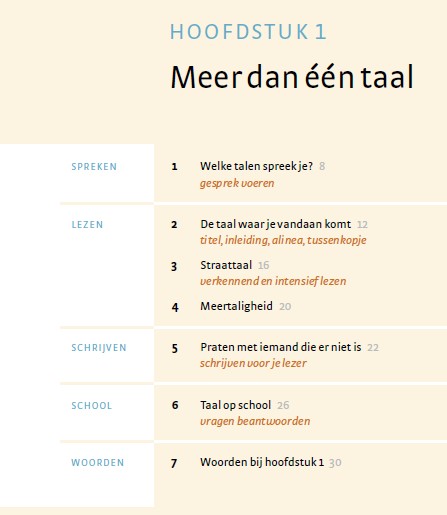
<table>
<tbody>
<tr>
<th>SPREKEN</th>
<td><p>1 Welke talen spreek je? <a type="pageRef" href="#pb-8">8</a></p>
<p fontStyles="italic" foregroundColor="orange">gesprek voeren</p></td>
</tr>
<tr>
<th rowspan="3">LEZEN</th>
<td><p>2 De taal waar je vandaan komt <a type="pageRef" href="#pb-12">12</a></p>
<p fontStyles="italic" foregroundColor="orange">titel, inleiding, alinea, tussenkopje</p></td>
</tr>
<tr>
<td><p>3 Straattaal <a type="pageRef" href="#pb-16">16</a></p>
<p fontStyles="italic" foregroundColor="orange">verkennend en intensief lezen</p></td>
</tr>
<tr>
<td>4 Meertaligheid <a type="pageRef" href="#pb-20">20</a></td>
</tr>
…
</tbody>
</table>
foregroundColor in <bodymatter>
There are colors used for main text: blue, orange and gray.
Process attribute foregroundColor with block-level elements, for example <p> or <list> or <table> or <linegroup>, NOT with <em>! But there are exceptions! See “Colored texts: exceptions”.
Sometimes two colors are used in the text. Then process the text with the main color.
Example 1: blue text
Process text with <p> and foregroundColor="blue".

<p foregroundColor="blue">DOEL → Je gaat met elkaar een gesprek voeren over de taal of talen die je spreekt.</p>Process text with <p> and <list> and foregroundColor="blue".
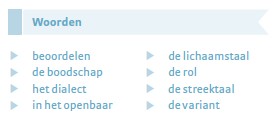
<p type="precedingEmptyLine" foregroundColor="blue">Woorden</p>
<list listType="unordered" bulletType="predefined" foregroundColor="blue">
<li>► beoordelen</li>
<li>► de boodschap</li>
<li>► het dialect</li>
…
</list>
Example 2: orange text
Process line with ► and empty line above with <p> and foregroundColor="orange". These lines appear between the assessments.
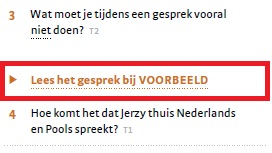
<p type="precedingEmptyLine" fontStyles="bold underline" foregroundColor="orange">► Lees het gesprek bij VOORBEELD</p>Process tables like below with <table> and foregroundColor="orange".
Process text above table with <p> and foregroundColor="gray".
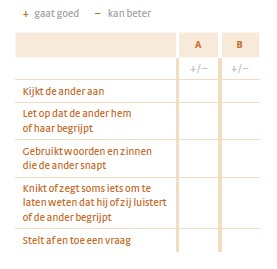
<p foregroundColor="gray">+ gaat goed</p>
<p foregroundColor="gray">- kan beter</p>
<table foregroundColor="orange">
<thead>
<tr>
<th></th>
<th>A</th>
<th>B</th>
</tr>
<tr>
<td></td>
<td>+/-</td>
<td>+/-</td>
</tr>
<tr>
<td>Kijkt de ander aan</td>
<td></td>
<td></td>
</tr>
…
</thead>
</table>
Example 3: gray text
Process text with <p> and foregroundColor="gray".
Process marked text with <em> and backgroundColor="lightYellow".
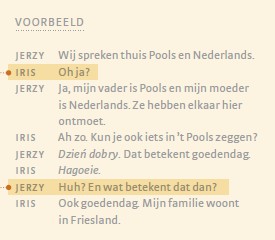
<p fontStyles="underline" foregroundColor="gray">VOORBEELD</p>
<p type="precedingEmptyLine" foregroundColor="gray">JERZY Wij spreken thuis Pools en Nederlands.</p>
<p foregroundColor="gray"><em backgroundColor="lightYellow">IRIS Oh ja?</em></p>
<p foregroundColor="gray">JERZY Ja, mijn vader is Pools en mijn moeder is Nederlands. Ze hebben elkaar hier ontmoet.</p>
…
Example 4: mix of colored texts
Process with one color.
Process numbers in same color as main text.
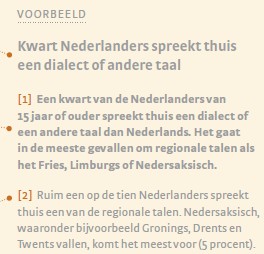
<p fontStyles="underline" foregroundColor="gray">VOORBEELD</p>
<p type="precedingEmptyLine" fontStyles="bold" foregroundColor="gray">Kwart Nederlanders spreekt thuis een dialect of andere taal</p>
<p type="precedingEmptyLine" fontStyles="bold" foregroundColor="gray">[1] Een kwart van de Nederlanders van ... het Fries, Limburgs of Nedersaksisch.</p>
<p type="precedingEmptyLine" foregroundColor="gray">[2] Ruim een op de tien Nederlanders spreekt ... Twents vallen, komt het meest voor (5 procent).</p>
Process heading with <p> and foregroundColor="gray".
Process numbers in same color as main text.
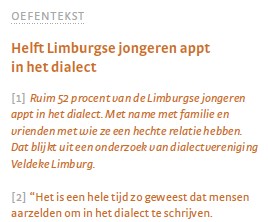
<p type="precedingEmptyLine" fontStyles="underline" foregroundColor="gray">OEFENTEKST</p>
<p type="precedingEmptyLine" fontStyles="bold" foregroundColor="orange">Helft Limburgse jongeren appt in het dialect</p>
<p type="precedingEmptyLine" fontStyles="italic" foregroundColor="orange">[1] Ruim 52 procent van de Limburgse jongeren ... Veldeke Limburg.</p>
<p type="precedingEmptyLine" foregroundColor="orange">[2] "Het is een hele tijd zo geweest dat mensen aarzelden om in het dialect te schrijven.</p>
Process “NIET” and “WEL” in same color as main text.
Do use <em> for words in the text that are bold, italic, underlined or otherwise.
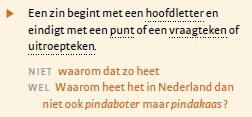
<p type="precedingEmptyLine">► Een zin begint met een <em type="underline">hoofdletter</em> en eindigt met een <em type="underline">punt</em> of een <em type="underline">vraagteken</em> of <em type="underline">uitroepteken</em>.</p>
<p foregroundColor="orange">NIET waarom dat zo heet</p>
<p foregroundColor="orange">WEL Waarom heet het in Nederland dan niet ook <em type="italic">pindaboter</em> maar <em type="italic">pindakaas</em>?</p>
Process with <p> and foregroundColor.
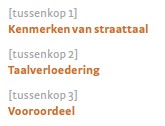
<p type="precedingEmptyLine" foregroundColor="gray">[tussenkop 1]</p>
<p fontStyles="bold" foregroundColor="orange">Kenmerken van straattaal</p>
<p type="precedingEmptyLine" foregroundColor="gray">[tussenkop 2]</p>
<p fontStyles="bold" foregroundColor="orange">Taalverloedering</p>
<p type="precedingEmptyLine" foregroundColor="gray">[tussenkop 3]</p>
<p fontStyles="bold" foregroundColor="orange">Vooroordeel</p>
Do use <em> for words in the text that are bold, italic, underlined or otherwise.
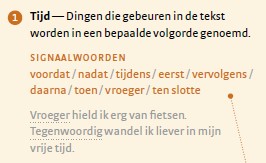
<p type="precedingEmptyLine"><em type="bold">1</em> <em type="bold">Tijd</em> — Dingen die gebeuren in de tekst worden in een bepaalde volgorde genoemd.</p>
<p type="precedingEmptyLine" foregroundColor="orange">SIGNAALWOORDEN</p>
<p foregroundColor="orange">voordat / nadat / tijdens / eerst / vervolgens / daarna / toen / vroeger / ten slotte</p>
<p type="precedingEmptyLine" foregroundColor="gray"><em type="underline">Vroeger</em> hield ik erg van fietsen.</p>
<p foregroundColor="gray"><em type="underline">Tegenwoordig</em> wandel ik liever in mijn vrije tijd.</p>
Colored texts: exceptions
When multiple colors are used in sentences in assessments, then process with <em> and foregroundColor.
<assessment>
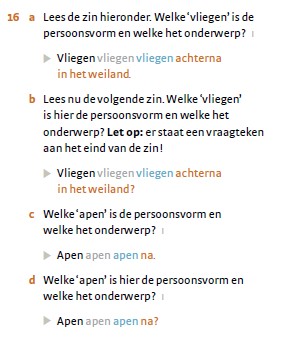
<title number="16" label="assessment">16</title>
<p><em type="bold">a</em> Lees de zin hieronder. Welke 'vliegen' is de persoonsvorm en welke het onderwerp? I</p>
<p>► Vliegen <em foregroundColor="gray">vliegen</em> <em foregroundColor="blue">vliegen</em> <em foregroundColor="orange">achterna in het weiland.</em></p>
<p><em type="bold">b</em> Lees nu de volgende zin. Welke 'vliegen' is hier de persoonsvorm en welke het onderwerp? <em type="bold">Let op:</em> er staat een vraagteken aan het eind vn de zin!</p>
<p>► Vliegen <em foregroundColor="gray">vliegen</em> <em foregroundColor="blue">vliegen</em> <em foregroundColor="orange">achterna in het weiland?</em></p>
…
</assessment>
Assessments
Note: the dotted line indicates end of an assessment and is not a input field!
Example 1: with gray text T1, T2, R or I (= capital letter i) at end of question
No need to process T1, T2, R or I with <em> and foregroundColor="gray".
Do use <em> for words in the text that are bold, italic, underlined or otherwise.
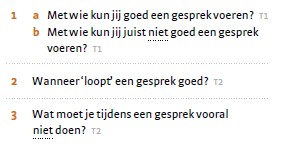
<assessment>
<title number="1" label="assessment">1</title>
<p><em type="bold">a</em> Met wie kun jij goed een gesprek voeren? T1</p>
<p><em type="bold">b</em> Met wie kun jij juist <em type="underline">niet</em> goed een gesprek voeren? T1</p>
</assessment>
<assessment>
<title number="2" label="assessment">2</title>
<p>Wanneer ‘loopt’ een gesprek goed? T2</p>
</assessment>
<assessment>
<title number="3" label="assessment">3</title>
<p>Wat moet je tijdens een gesprek vooral <em type="underline">niet</em> doen? T2</p>
</assessment>
Example 2: with colored text
Combination exercise: process with <figure> and <altRepresentation>.
Process with <list> and foregroundColor="orange" and foregroundColor="gray".
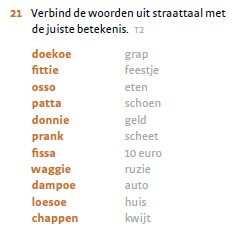
<assessment>
<title number="21" label="assessment">21</title>
<p>Verbind de woorden uit straattaal met de juiste betekenis. T2</p>
<figure>
<img alt="" role="informative" src="/img/000000_p000-1.jpg" type="screenshot">
<altRepresentation>
<p>Lijst 1:</p>
<list listType="unordered" bulletType="none" foregroundColor="orange">
<li>doekoe</li>
<li>fittie</li>
<li>osso</li>
…
</list>
<p>Lijst 2:</p>
<list listType="unordered" bulletType="none" foregroundColor="gray">
<li>grap</li>
<li>feestje</li>
<li>eten</li>
…
</list>
</altRepresentation>
</img>
</figure>
</assessment>
Process colored text with <p> and foregroundColor="orange".
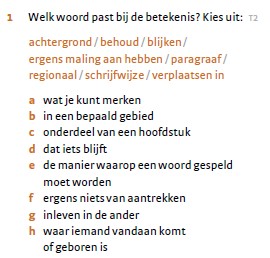
<assessment>
<title number="1" label="assessment">1</title>
<p>Welk woord past bij de betekenis? Kies uit: T2</p>
<p foregroundColor="orange">achtergrond / behoud / blijken / ergens maling aan hebben / paragraaf / regionaal / schrijfwijze / verplaatsen in</p>
<p><em type="bold">a</em> wat je kunt merken</p>
<p><em type="bold">b</em> in een bepaald gebied</p>
<p><em type="bold">c</em> onderdeel van een hoofdstuk</p>
…
</assessment>
Example 3: with colored text in sentences
If colored text are between parentheses in sentences, then no need to process with <em> and foregroundColor.
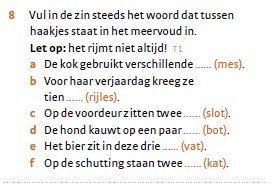
<assessment>
<title number="8" label="assessment">8</title>
<p>Vul in de zin steeds het woord dat tussen haakjes staat in het meervoud in.</p>
<p><em type="bold">Let op</em>: het rijmt niet altijd! T1</p>
<p><em type="bold">a</em> De kok gebruikt verschillende ... (mes).</p>
<p><em type="bold">b</em> Voor haar verjaardag kreeg ze tien ... (rijles).</p>
<p><em type="bold">c</em> Op de voordeur zitten twee ... (slot).</p>
…
</assessment>
Page with background color
Process text with <frame>.
Example 1: with heading “BELANGRIJK”
Process text with <frame>.
Process text on the right first, then text on the left.
Process gray text with <p> and foregroundColor. Do use <em> for words in the text that are bold, italic, underlined or otherwise: in this example marked text with <em> and backgroundColor="lightYellow".
Ignore the dotted lines between text on the right and on the left.
Pay attention to text with ►:
- If there is an empty line above, then process with
<p>. - If there is no empty line above, then process with
<list>.
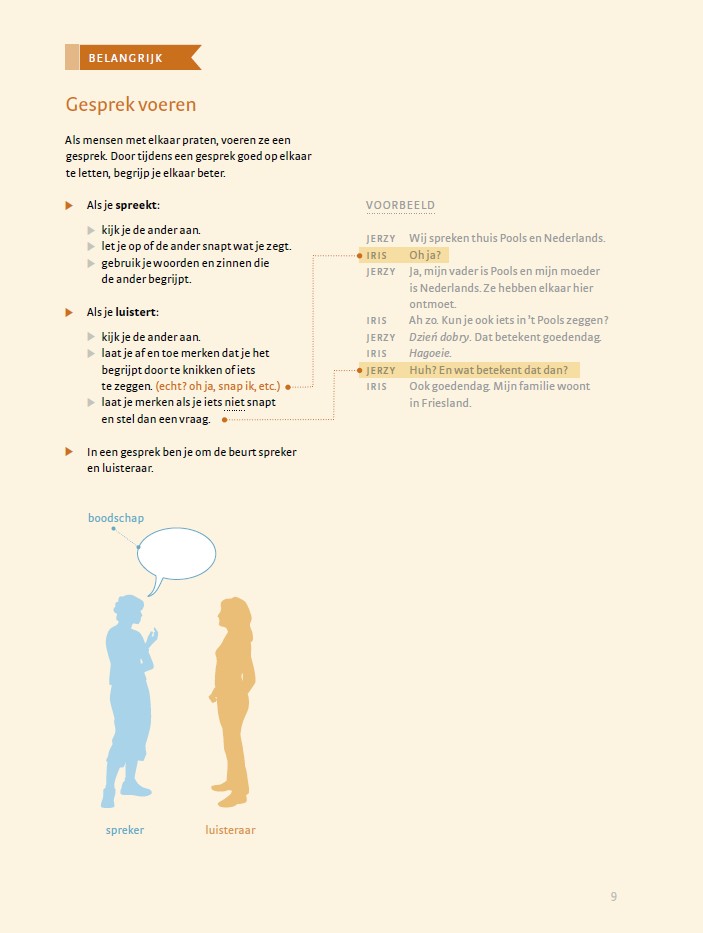
<frame>
<title>BELANGRIJK</title>
<subtitle>Gesprek voeren</subtitle>
<p>Als mensen met elkaar praten, voeren ze een gesprek. Door tijdens een gesprek goed op elkaar te letten, begrijp je elkaar beter.</p>
<p type="precedingEmptyLine">► Als je <em type="bold">spreekt</em>:</p>
<list listType="unordered" bulletType="predefined">
<li>► kijk je de ander aan.</li>
<li>► let je op of de ander snapt wat je zegt.</li>
<li>► gebruik je woorden en zinnen die de ander begrijpt.</li>
</list>
<p>► Als je <em type="bold">luistert</em>:</p>
<list listType="unordered" bulletType="predefined">
<li>► kijk je de ander aan.</li>
<li>► laat je af en toe merken dat je het begrijpt door te knikken of iets te zeggen. (echt? oh ja, snap ik, etc.)</li>
<li>► laat je merken als je iets niet snapt en stel dan een vraag.</li>
</list>
<p>► In een gesprek ben je om de beurt spreker en luisteraar.</p>
<figure>
<img alt="" role="informative" src="/img/000000_p000-1.jpg" type="drawing"/>
</figure>
<p type="precedingEmptyLine" fontStyles="underline" foregroundColor="gray">VOORBEELD</p>
<p type="precedingEmptyLine" foregroundColor="gray">JERZY Wij spreken thuis Pools en Nederlands.</p>
<p foregroundColor="gray"><em backgroundColor="lightYellow">IRIS Oh ja?</em></p>
<p foregroundColor="gray">JERZY Ja, mijn vader is Pools en mijn moeder is Nederlands. Ze hebben elkaar hier ontmoet.</p>
…
</frame>
Example 2: without heading “BELANGRIJK”
These texts are reading texts.
Process text with <frame>.
No need to process the main text in orange with foregroundColor, because <frame> is used.
Do use <em> for words in the text that are bold, italic, underlined or otherwise.
Process headings with <hd>.
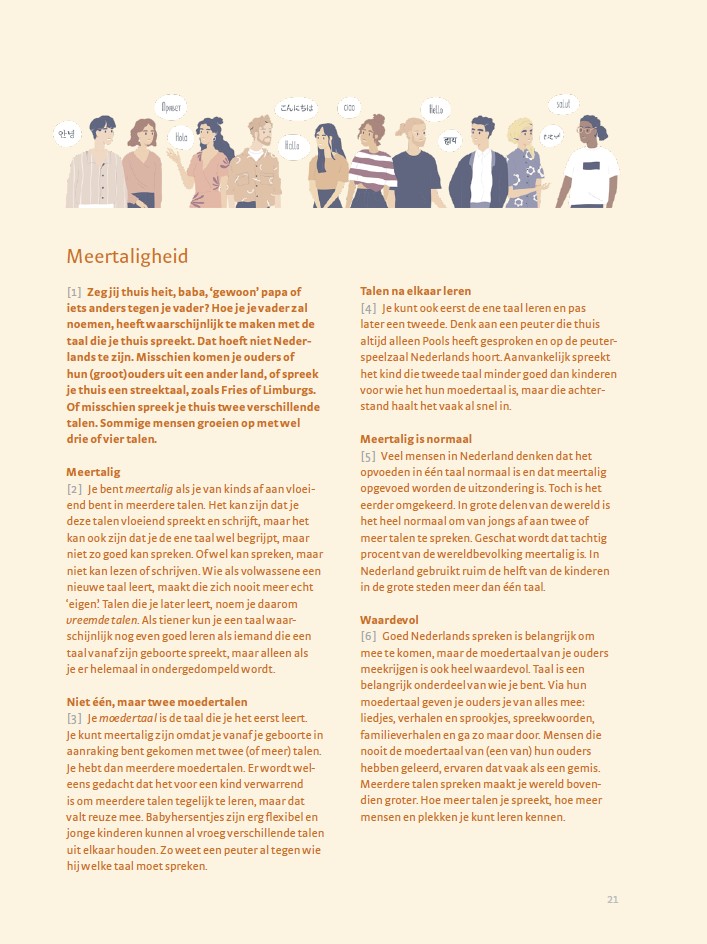
<hd>Meertalig</hd>
<p>[2] Je bent <em type="italic">meertalig</em> als je van kinds af aan vloeiend bent in meerdere talen. Het kan zijn dat je deze talen vloeiend spreekt en schrijft, maar het kan ook zijn dat je de ene taal wel begrijpt, maar niet zo goed kan spreken. Of wel kan spreken, maar niet kan lezen of schrijven. Wie als volwassene een nieuwe taal leert, maakt die zich nooit meer echt ‘eigen’. Talen die je later leert, noem je daarom <em type="italic">vreemde talen</em>. Als tiener kun je een taal waarschijnlijk nog even goed leren als iemand die een taal vanaf zijn geboorte spreekt, maar alleen als je er helemaal in ondergedompeld wordt.</p>
Boxed text with heading “BELANGRIJK”
Process text with <frame>.
No need to process the main text in orange with foregroundColor, because <frame> is used.
Process gray text with <p> and foregroundColor="gray".
Do use <em> for words in the text that are bold, italic, underlined or otherwise.
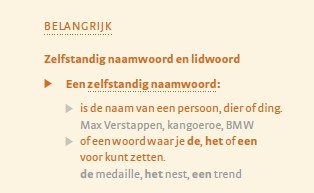
<frame>
<title>BELANGRIJK</title>
<hd>Zelfstandig naamwoord en lidwoord</hd>
<p fontStyles="bold">► Een <em type="underline">zelfstandig naamwoord</em>:</p>
<list listType="unordered" bulletType="predefined">
<li><p>► is de naam van een persoon, dier of ding.</p>
<p foregroundColor="gray">Max Verstappen, kangoeroe, BMW</p></li>
<li><p>► of een woord waar je <em>de, het</em> of <em>een</em> voor kunt zetten.</p>
<p foregroundColor="gray"><em type="bold">de</em> medaille, <em type="bold">het</em> nest, <em type="bold">een</em> trend</p></li>
</list>
</frame>
Text with ►
Pay attention to text with ►:
- If there is an empty line above, then process with
<p>. - If there is no empty line above, then process with
<list>.
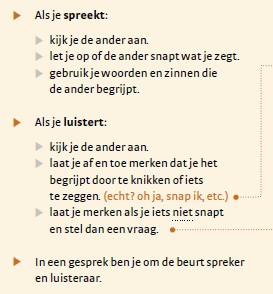
<p type="precedingEmptyLine">► Als je <em type="bold">spreekt</em>:</p>
<list listType="unordered" bulletType="predefined">
<li>► kijk je de ander aan.</li>
<li>► let je op of de ander snapt wat je zegt.</li>
<li>► gebruik je woorden en zinnen die de ander begrijpt.</li>
</list>
<p>► Als je <em type="bold">luistert</em>:</p>
<list listType="unordered" bulletType="predefined">
<li>► kijk je de ander aan.</li>
<li>► laat je af en toe merken dat je het begrijpt door te knikken of iets te zeggen. (echt? oh ja, snap ik, etc.)</li>
<li>► laat je merken als je iets niet snapt en stel dan een vraag.</li>
</list>
<p>► In een gesprek ben je om de beurt spreker en luisteraar.</p>